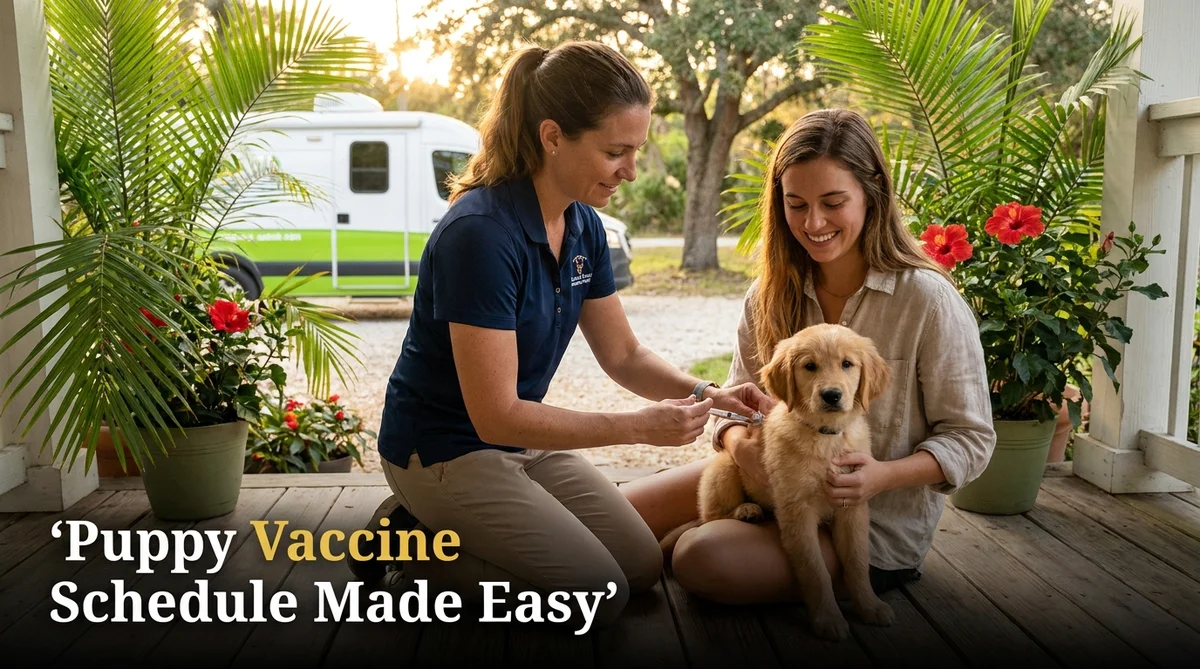
Your new puppy needs three to four rounds of core puppy shots between 6 and 16 weeks of age. The core series covers DHPP (distemper, hepatitis, parainfluenza, parvovirus) plus a rabies shot at 14 to 16 weeks. Lifestyle add-ons like Bordetella, Leptospirosis, and Canine Influenza layer in based on where your puppy lives, plays, and travels. In Orlando, the full puppy series runs about $200 to $300 across all visits, and you can book the whole schedule with at-home puppy shots in Orlando without ever taking a partially protected puppy into a clinic full of unvaccinated dogs.
The chart below is the version most central-Florida puppies follow. Specifics vary by breed, health status, and exposure risk, which is why this guide ends with a personalization disclaimer and a reference to AAHA's 2022 Canine Vaccination Guidelines. The protocol is well-established. The how-and-where is what you control.
Quick Puppy Vaccine Schedule
- 6-8 weeks: DHPP #1
- 10-12 weeks: DHPP #2 + Bordetella + Leptospirosis #1
- 14-16 weeks: DHPP #3 + Leptospirosis #2 + Rabies
- 12+ months: DHPP booster + Rabies booster
- Full puppy series cost (Orlando): $200-$300
Call (877) 345-4326 to schedule the whole series with one of our licensed Florida veterinarians, or read on for the full breakdown.
What Vaccines Does Your Puppy Need (Core vs Non-Core)
Veterinary medicine sorts puppy vaccines into two buckets: core and lifestyle. Core vaccines protect against diseases that are either widespread, life-threatening, or transmissible to humans. The American Animal Hospital Association recommends core vaccines for every puppy in North America, regardless of where they live or how they spend their day.
Core vaccines (every puppy, every state):
- DHPP or DAPP: the combination shot that protects against canine distemper, hepatitis (adenovirus), parainfluenza, and parvovirus. Parvovirus alone kills roughly 90% of untreated puppies and remains endemic in Florida soil for months. This is the shot you cannot skip.
- Rabies: required by Florida law for any dog over four months of age. Rabies is nearly 100% fatal once symptoms appear and is transmissible to people. Florida Statute 828.30 makes this one non-negotiable.
Lifestyle vaccines (based on exposure risk):
- Bordetella bronchiseptica: the kennel cough vaccine. Recommended for puppies who will visit boarding facilities, daycare, grooming salons, training classes, or Orlando dog parks. Bordetella spreads through respiratory droplets in those exact environments.
- Leptospirosis: a bacterial disease that lives in standing water, mud, and wildlife urine. Central Florida's year-round humidity, ponds, and abundant raccoon and rodent population make Lepto a real risk here, not a theoretical one. AAHA now treats Lepto as a "core for some regions" vaccine, and Florida is one of those regions.
- Canine Influenza (H3N2 and H3N8): recommended for puppies who attend daycare, group training, or boarding. Outbreaks tend to cluster in social-dog environments.
- Lyme disease: relevant for puppies who hike, camp, or live near wooded areas with deer-tick exposure. Less common in urban Orlando but worth discussing if your family spends weekends in north Florida.
The choice between core-only and core-plus-lifestyle is a conversation with your veterinarian, not a one-size formula. A puppy who lives in a downtown apartment and never visits a dog park has a different risk profile than a puppy who joins a doggy-daycare cohort three days a week. The AAHA guidelines name the options; your DVM weighs them against your puppy's life.
Puppy Vaccine Schedule by Age
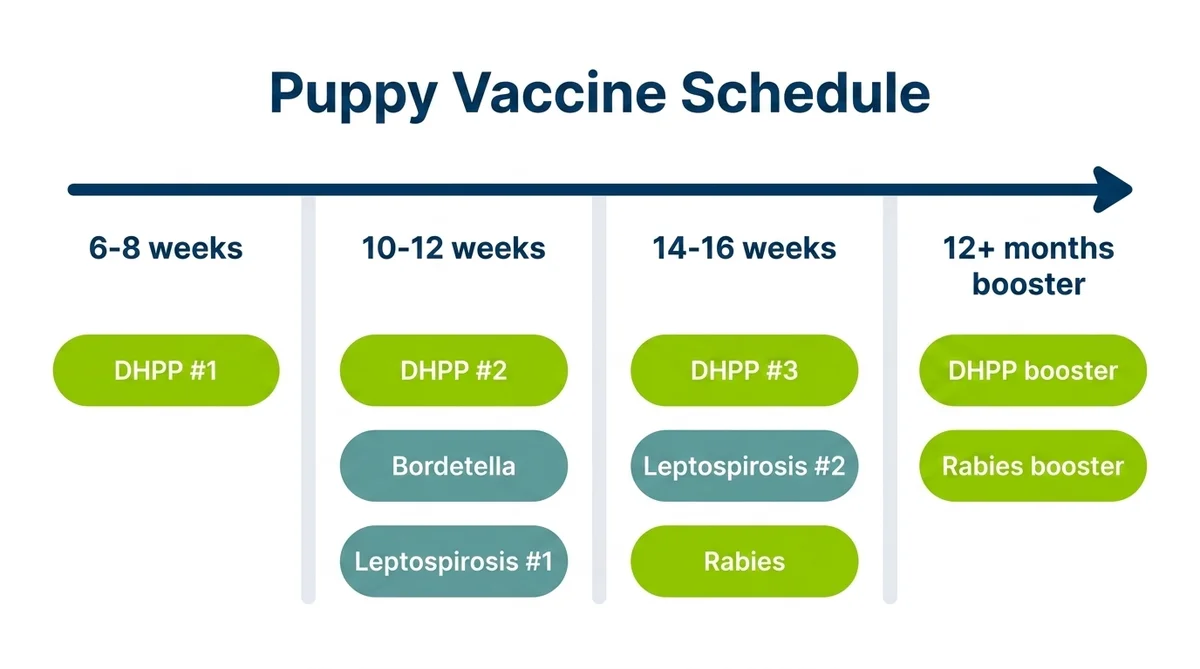
Here is the standard puppy vaccine schedule by age. Most Orlando puppies follow this exact pattern, with lifestyle add-ons adjusted to fit the family's situation.
| Visit | Age | Core Vaccines | Lifestyle Add-Ons (if applicable) |
|---|---|---|---|
| Visit 1 | 6-8 weeks | DHPP #1 | — |
| Visit 2 | 10-12 weeks | DHPP #2 | Bordetella, Leptospirosis #1, Canine Influenza #1 |
| Visit 3 | 14-16 weeks | DHPP #3, Rabies | Leptospirosis #2, Canine Influenza #2, Lyme |
| Visit 4 (booster) | 12-16 months | DHPP booster, Rabies booster | Annual lifestyle boosters |
Visits are spaced three to four weeks apart for a reason. The gap allows the puppy's immune system to mount a full response to each dose before the next one arrives. Spacing them closer together does not speed up immunity; spacing them too far apart leaves windows where maternal antibodies have faded but vaccine protection has not yet built. AAHA's recommended interval is three to four weeks between core doses through 16 weeks of age.
The 14-to-16-week visit matters most. That is the dose veterinarians refer to when they say a puppy is "fully vaccinated." Before that point, maternal antibodies may still neutralize the vaccine in some puppies. After it, your puppy has a complete immune response to parvo, distemper, and rabies. Until that final dose, treat your puppy as partially protected.
Most Orlando families pair the 6-to-8-week visit with a new-puppy wellness exam + vaccines bundle so the same appointment covers the first shots, a baseline physical, parasite screening, and the conversation about lifestyle vaccines. From there, the rest of the series is shots-only, quick, predictable visits.
Booking all four visits with mobile pet vaccinations in Orlando means your puppy never sits in a waiting room. We bring the full vaccine inventory in temperature-controlled storage, administer in your living room or yard, and update your records before we leave. One travel fee covers the litter if you adopted siblings.
How Much Do Puppy Shots Cost in Orlando
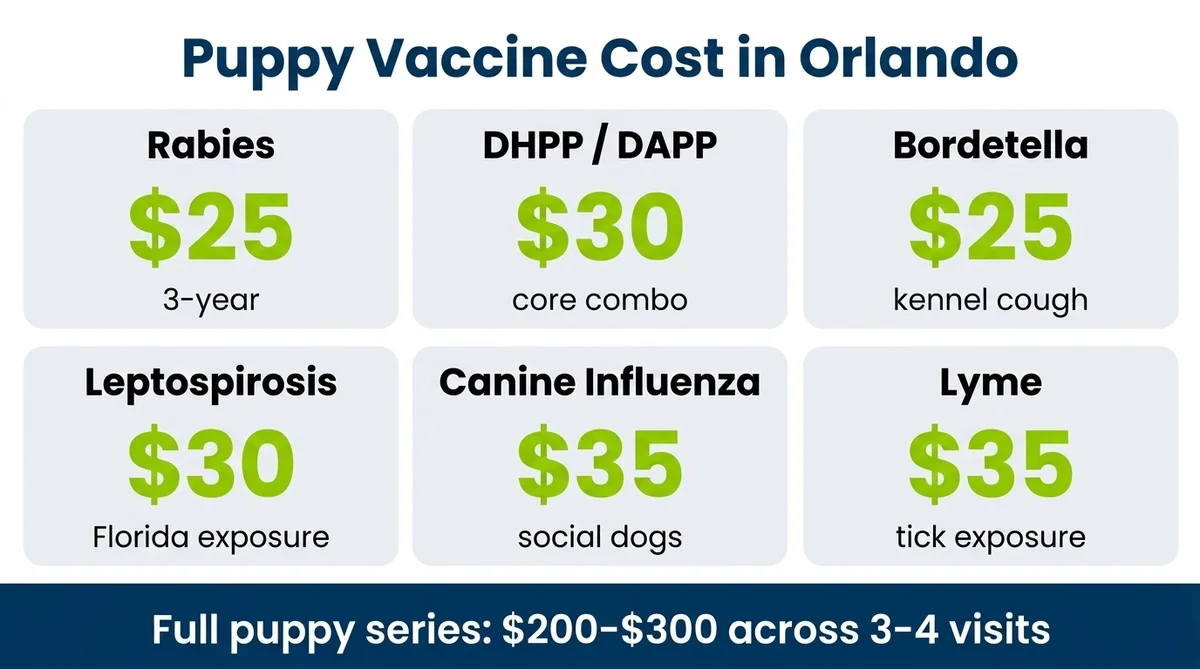
Individual puppy shots in Orlando run $25 to $45 per vaccine. The full puppy series, covering three to four DHPP rounds plus rabies plus typical lifestyle add-ons, lands in the $200 to $300 range total across all visits. That figure does not include exam fees if you bundle wellness visits.
Here is the per-vaccine breakdown most Orlando mobile vets charge in 2026:
| Vaccine | Price | Notes |
|---|---|---|
| Rabies (3-year) | $25 | Required by Florida Statute 828.30 |
| DHPP / DAPP | $30 | Core combo, given 3 times during series |
| Bordetella | $25 | Required by most boarders and daycares |
| Leptospirosis | $30 | Recommended in Florida, outdoor exposure |
| Canine Influenza | $35 | For social-dog environments |
| Lyme | $35 | For hiking and rural exposure |
A 12-week visit that includes DHPP plus Leptospirosis plus Bordetella adds up to roughly $85 in vaccines. Add a $50 to $75 travel fee for a mobile visit, and that single appointment lands between $135 and $160 all-in. For a comprehensive picture, see our complete breakdown of mobile vet costs in Orlando.
Low-cost alternatives exist for families on tight budgets. Orange County hosts periodic rabies-only clinics through Animal Services. ASPCA partner clinics in central Florida sometimes offer reduced-cost vaccine days. Tractor Supply hosts mobile vaccine clinics in surrounding counties with vaccines starting around $15. These options work for vaccine-only visits, though they typically do not include the new-puppy physical exam where a vet catches early heart murmurs, congenital issues, or parasite loads.
The honest comparison: a low-cost clinic gets the shots into the puppy. A wellness-paired visit with a licensed DVM, mobile or in-clinic, gets the shots into the puppy plus a baseline health record, a personalized lifestyle-vaccine recommendation, and someone who knows your puppy when something goes wrong. Many families also discover that pet insurance reimburses preventive care when those visits happen through a licensed practice, which closes most of the price gap with low-cost clinics anyway.
Mobile vet pricing in Orlando includes the travel fee once per visit, regardless of how many pets you have in the household. Adopted two littermates? One travel fee covers both. The full pricing list and at-home puppy shots page show every charge upfront, no surprises.
Side Effects and What to Watch For
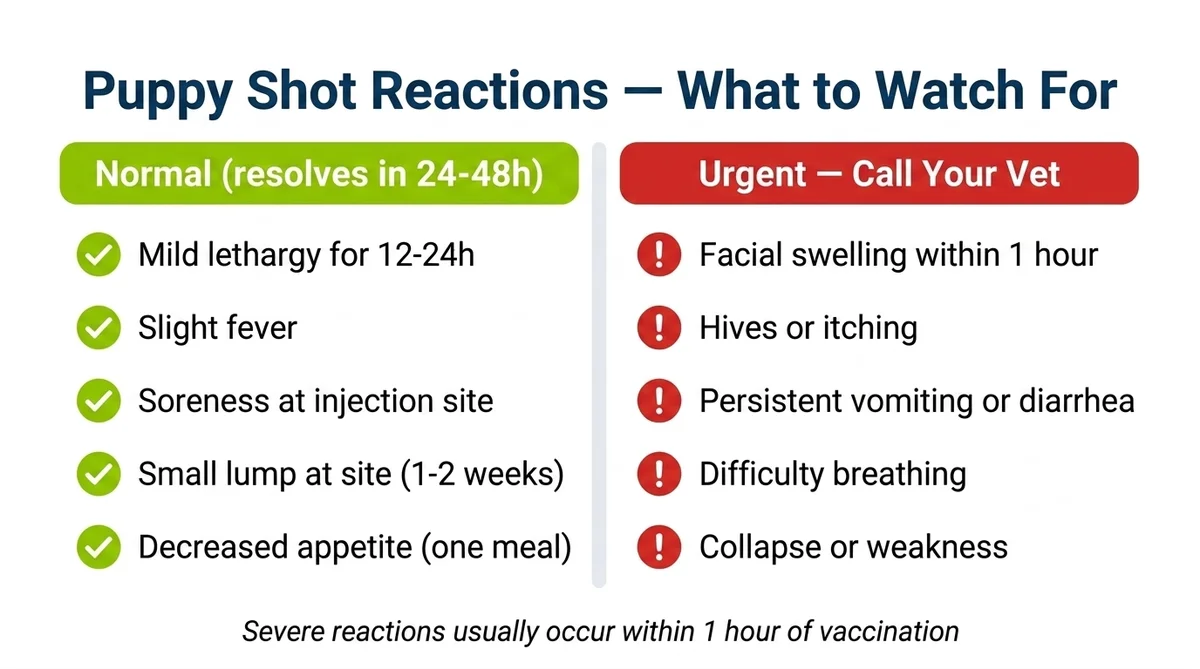
Most puppies handle vaccines without any noticeable reaction. Some get a mild response, which is the immune system doing exactly what it should. A small percentage have an adverse reaction that needs a phone call or, rarely, an emergency visit. Knowing which is which prevents both unnecessary panic and dangerous delay.
Normal post-vaccine reactions appear within 24 hours and resolve within 24 to 48 hours:
- Mild lethargy for the first 12 to 24 hours. Your puppy sleeps more and plays less
- A slight fever, typically less than one degree above normal
- Soreness or tenderness at the injection site
- A small firm lump at the injection site that resolves over one to two weeks
- Decreased appetite for one meal, occasionally two
These reactions do not require treatment. Quiet, comfortable rest is enough. If your puppy seems uncomfortable, a soft bed in a calm room is the standard advice. A reaction that lasts more than 48 hours warrants a phone call to your vet, even if it stays mild.
Urgent reactions require an immediate vet call, usually within the first hour after the vaccine:
- Facial swelling, especially around the muzzle, eyes, or ears
- Hives or sudden persistent itching
- Vomiting or diarrhea that does not stop after one episode
- Difficulty breathing, wheezing, or noisy breathing
- Collapse, extreme weakness, or pale gums
These signs suggest anaphylaxis, an allergic reaction that can escalate quickly. The good news is that anaphylactic reactions to puppy shots are rare, with reported rates around 1 in 250,000 doses. The bad news is that when they happen, minutes matter. If you see any of those signs, call your veterinarian or our 24/7 mobile emergency vet immediately.
A small lump at the injection site is normal and almost always resolves on its own within a week or two. A lump that grows, becomes painful, ulcerates, or persists beyond three weeks deserves a vet check. Vaccine-associated sarcomas in dogs are vanishingly rare, but the rule of thumb is the "3-2-1 rule". A lump that is larger than 2 cm, persists more than 3 months, or grows after 1 month should be examined.
The single most important rule: most severe reactions occur within an hour of vaccination. Stay with your puppy for the first hour. If something seems wrong in that window, call. Faster intervention almost always means a faster, simpler resolution.
When Can My Puppy Go Outside?
This question creates the most anxiety for new puppy parents, and the answer is not simply "after the last shot." It is more nuanced, and the nuance matters.
The classic veterinary advice was strict: keep the puppy inside until two weeks after the final 16-week shot, around 18 weeks total. The rationale was parvo exposure. Parvovirus survives in soil for months, and an unvaccinated or partially vaccinated puppy who walks across contaminated ground can pick it up and die from it.
The problem with strict isolation is that the puppy socialization window closes at around 14 to 16 weeks. That is the developmental period during which puppies learn what people, sounds, surfaces, and other dogs are normal. A puppy who spends weeks 8 to 18 isolated indoors often grows into an adult who fears strangers, fears traffic, fears other dogs, and fears the vet. The behavioral cost is real, and behavioral problems are the leading cause of dogs being relinquished to shelters.
Modern guidance, including the position statement from the American Veterinary Society of Animal Behavior (AVSAB), is more practical. Controlled socialization can begin one week after the first vaccine, in low-risk environments:
Low-risk socialization (encouraged starting week 7-8):
- Carry your puppy through new environments. Shopping centers, the hardware store, friends' houses
- Invite visitors to your home
- Introduce your puppy to fully vaccinated adult dogs in private yards
- Enroll in a puppy class that requires proof of current vaccinations
- Walk on concrete sidewalks in your own neighborhood, avoiding grass
High-risk environments to avoid until 1 week after the final shot:
- Public dog parks
- Pet store floors (especially the grassy patches near entrances)
- Communal grass at apartment complexes
- Doggy daycare with unknown vaccination status
- Areas where wildlife frequents
Orlando dog parks are great places once your puppy is fully vaccinated, but they belong in the second category until then. The same applies to the grass strips outside grocery stores, which see hundreds of unvaccinated dogs and are a known transmission point.
The mobile vet angle quietly solves part of this. Booking at-home puppy shots means your puppy never sets paw inside a veterinary clinic during the high-risk window. Clinics are exactly where unvaccinated puppies meet sick dogs, parvo-shedding patients, and stressed adults. Removing that exposure from the schedule is one of the cleanest risk-reduction moves you can make in the first three months.
What If You Miss a Booster
Life happens. A vacation, a sick week, a moving box that hid the appointment reminder. Puppies miss boosters all the time, and most of the time it is fixable without restarting from zero.
If you are less than two weeks late: Resume the schedule where it left off. The next dose still counts as the next dose. Immunity from the previous shot is still active.
If you are two to six weeks late: Call your veterinarian. Many DVMs will add one extra booster dose to make sure immunity is solid before declaring the series complete. The reason is that the timing between doses affects how reliably each one boosts the previous one. A wide gap may leave a window of partial protection.
If you are more than six weeks late: Your vet will likely restart the series from the most recent dose, with three or four weeks between subsequent shots. Maternal antibodies are no longer in play by this age, so the restarted series tends to be shorter than the original.
Do not skip rabies under any circumstance. Florida Statute 828.30 makes rabies vaccination a legal requirement, and rabies is lethal once symptoms appear. There is no titer test, herbal alternative, or homeopathic substitute that satisfies the law. If your puppy missed the 14-to-16-week rabies dose, schedule it now.
A catch-up appointment is the cleanest way to handle a missed booster. Book a wellness exam + vaccines bundle and your vet can run a quick physical, confirm where you are in the series, and administer whatever the schedule calls for. The whole visit takes about 30 minutes at home.
Why Get Puppy Shots at Home in Orlando
A traditional vet-clinic waiting room is exactly the place where a partially vaccinated puppy is most at risk. Sick dogs come in for treatment. Stressed adults pace and shed bacteria. The floor and grass strip outside have been crossed by hundreds of unvaccinated animals. For a healthy adult dog, this is fine. For an 8-week-old puppy whose immune system is still building protection, it is one of the highest-risk environments in the city.
At-home puppy shots in Orlando eliminate that exposure entirely. The advantages compound:
- Zero clinic exposure. Your puppy never breathes the same air as parvo-shedding dogs or coughing patients
- Lower stress. No carrier battle, no car ride, no slick exam-table floor, no barking neighbors. Puppies stay calmer, and a calm puppy is easier to examine
- Schedule flexibility. Evening and weekend appointments are available, including times when traditional clinics are closed
- One visit, whole litter. Adopted siblings? One travel fee covers all of them
- Continuity of care. The same team sees your puppy from the 6-week visit through adulthood, so your puppy's full history travels with us
Our licensed Florida veterinarians handle the full puppy series, including rabies and all lifestyle vaccines. Vaccines travel with us in temperature-controlled storage and are administered the same day they are drawn. Florida DVM licensure is verified through the Department of Business and Professional Regulation, and every clinician on our team is current with AAHA continuing-education standards.
Most new-puppy families book the first visit as a wellness exam + vaccines bundle, which adds a full physical exam, fecal parasite screen, and a heart-and-lung listen to the schedule. From there, follow-up visits are shots-only, quick, predictable, and stress-free.
To book the full puppy series, call (877) 345-4326 or use the online form on our vaccinations service page. We serve service areas across greater Orlando, including Winter Park, Altamonte Springs, Kissimmee, and most of Orange and Seminole counties.
Putting It Together
The plan, in plain terms: three to four rounds of core shots between 6 and 16 weeks, a rabies shot at 14 to 16 weeks, a year-one booster, then continued boosters every one to three years. Layer in lifestyle vaccines based on where your puppy actually spends time. Watch for reactions in the first hour. Socialize cautiously but actively, avoiding parvo-risk environments until a week after the final shot. Expect to spend $200 to $300 on the full series in Orlando, and book through a licensed Florida DVM so the visits are reimbursable through pet insurance and accepted by every boarder, groomer, and trainer your puppy will encounter for the next 15 years.
The shots are not the hard part. Picking a provider you trust, who can come to your home and pull the whole series together with one phone call, is the part most parents wish they had figured out earlier.
To book at-home puppy shots in Orlando, call (877) 345-4326 or visit our mobile vaccinations service page. We will walk you through the schedule, confirm pricing for your specific puppy, and book the first visit at a time that fits your week.
This guide shares general guidance based on AAHA's 2022 Canine Vaccination Guidelines and AVMA recommendations. Every puppy is different — your veterinarian will tailor the exact schedule, lifestyle vaccine recommendations, and timing to your puppy's breed, health status, and exposure profile. Always consult a licensed veterinarian for medical decisions about your specific pet. Last updated: 2026-05-27.
References
- American Animal Hospital Association (AAHA). "2022 Canine Vaccination Guidelines." aaha.org/aaha-guidelines/2022-aaha-canine-vaccinations-guidelines
- American Veterinary Medical Association (AVMA). "Vaccinations for Your Pet." avma.org/resources-tools/pet-owners/petcare/vaccinations-your-pet
- American Veterinary Society of Animal Behavior (AVSAB). "Position Statement on Puppy Socialization." avsab.org/resources/position-statements
- Florida Department of Agriculture and Consumer Services. "Florida Rabies Statute 828.30." flsenate.gov/Laws/Statutes/2023/828.30
Frequently Asked Questions
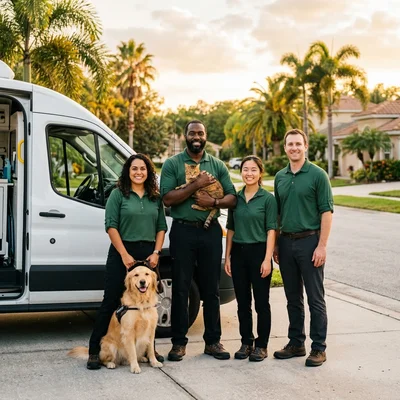
Our team of licensed veterinarians brings compassionate care directly to your home.