

- Physical Signs Your Pet May Be Nearing End of Life
- Cat-Specific Signs to Watch
- Behavioral and Emotional Changes to Watch For
- Quality of Life Assessment Tools
- How the HHHHHMM Scale Works
- Track the Trend, Not the Snapshot
- Your Pet's Favorites List
- How to Make the Decision: A Step-by-Step Guide
- In-Home Euthanasia: A Peaceful Alternative
- Coping With Pet Loss and Grief
- Your Pet Gave You Their Best Days
- References
Nobody looks up signs it's time to say goodbye to a pet on a good day. You're here because something has changed. Your dog won't eat, your cat has stopped grooming, or a look in your pet's eyes tells you what words can't.
We built this guide for that exact moment. Not to push you toward a decision, but to hand you a clear framework for making one. Below you'll find the physical signs veterinarians watch for, a quality of life assessment you can use at home, and practical, step-by-step guidance on deciding whether it's time. Everything here reflects current AVMA guidelines and the clinical experience of our licensed veterinary team, who sit with Orlando families through these conversations every week.
Read at your own pace. Come back to it when you need to.
Physical Signs Your Pet May Be Nearing End of Life
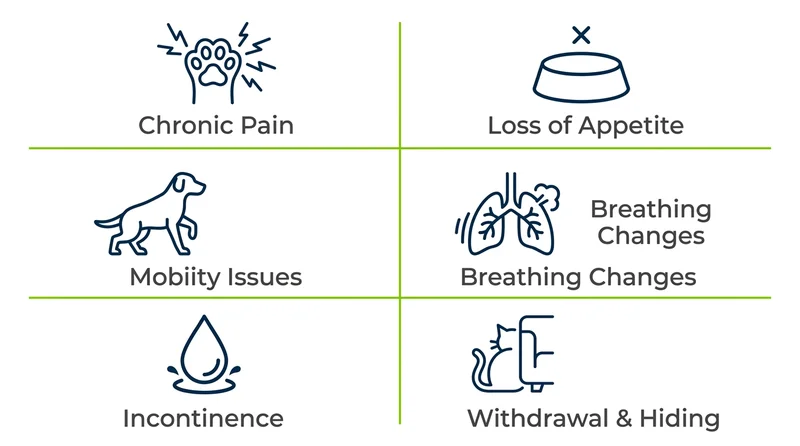
Bodies send signals. Some are subtle at first, easy to explain away as a rough day. Others are impossible to ignore. Knowing which signs to watch for helps you separate a temporary setback from a pattern that points toward irreversible decline.
Chronic pain that no longer responds to treatment. Medication that used to bring relief now barely takes the edge off. Your pet pants at rest, guards certain body parts when touched, or cries out during position changes. Dogs with terminal cancer may tremble while lying down. Cats with advanced kidney disease often sit hunched over the water bowl, too nauseated to drink.
Loss of appetite and refusal to drink. Skipping one meal happens. Refusing food for two or three consecutive days, especially favorite treats, signals something deeper. When pets stop drinking water altogether, dehydration accelerates decline within hours. Dogs that turn away from peanut butter, cats that ignore tuna -- they're telling you something words can't express.
Severe mobility loss. Struggling to stand differs from post-nap stiffness. End-of-life mobility loss looks like collapse when attempting to rise, dragging hind legs, or inability to reach the water bowl without help. Large dogs may need to be carried outside for bathroom needs. Cats may abandon their usual perches entirely and stay on the floor.
Labored breathing. Rapid, shallow breathing at rest warrants immediate concern. Open-mouth breathing in cats is always an emergency sign regardless of underlying cause. Persistent coughing that prevents sleep, fluid buildup in the chest or abdomen creating visible effort with every breath -- these patterns rarely reverse without aggressive intervention.
Loss of bladder or bowel control. Accidents that go well beyond an occasional slip deserve attention. Many pets experience genuine distress when they soil themselves or their bedding. Previously house-trained dogs lying in urine without attempting to move signals both physical decline and a loss of the awareness that once mattered to them.
Withdrawal and hiding. Dogs that once greeted you at the door now stay in a corner. Cats disappear under beds or into closets for hours at a stretch. Sick animals isolate themselves -- this instinct runs deep. When your pet actively avoids the family they've spent years shadowing from room to room, that behavioral shift carries real weight.
Cat-Specific Signs to Watch
Cats mask illness better than dogs. By the time a cat shows obvious distress, the underlying condition is often advanced.
Watch for these cat-specific signals: stopping self-grooming (a matted or greasy coat on a formerly fastidious cat), changes in purring patterns (purring can indicate pain, not just contentment), repeated trips to the litter box with little result, and sudden weight loss visible in the spine and hip bones. Cats sitting face-first toward a wall or staring blankly into space for extended periods may be experiencing neurological decline.
If your cat shows signs of distress during veterinary visits, our guide on keeping your cat calm explains how mobile exams eliminate the stress of a clinic trip, especially for cats who are already fragile.
Behavioral and Emotional Changes to Watch For
Physical signs tell part of the story. Who your pet used to be versus who they are now tells the rest.
Loss of joy. This one breaks people. Your dog hears the leash jingle and doesn't lift their head. Your cat ignores the red laser dot. Whatever once made their whole body vibrate with excitement now gets zero reaction. When the activities that defined your pet's personality no longer register, quality of life has shifted fundamentally.
Personality changes. Gentle dogs that start snapping when touched. Social cats that hiss at family members who've been around for years. Pain and cognitive decline alter behavior in ways that can feel like your pet has become someone else entirely. These changes aren't choices. They're symptoms.
Social withdrawal beyond hiding. Not just retreating to a quiet room, but disconnecting from the household rhythm entirely. Missing meals not because of nausea, but because participation in family routines has stopped mattering. Sleeping through events that used to bring them running.
Nighttime restlessness and anxiety. Pacing, vocalizing, or inability to settle after dark -- these patterns often intensify as the house goes quiet. In senior dogs, nighttime agitation can indicate cognitive dysfunction or unmanaged pain that surfaces once distractions disappear.
That look. Veterinarians and experienced pet owners describe something hard to quantify: eyes that have gone flat. Brightness, engagement, the spark that made them them -- gone. You've spent years reading your pet's face. Trust what you see in it now.
Pain versus anxiety: These present differently. Pets in pain tend to be still, guarded, reluctant to move. Pets with anxiety pace, pant, vocalize, and can't settle. Both reduce quality of life, but they require different management approaches. Your vet can help distinguish between them and address each one appropriately.
Quality of Life Assessment Tools
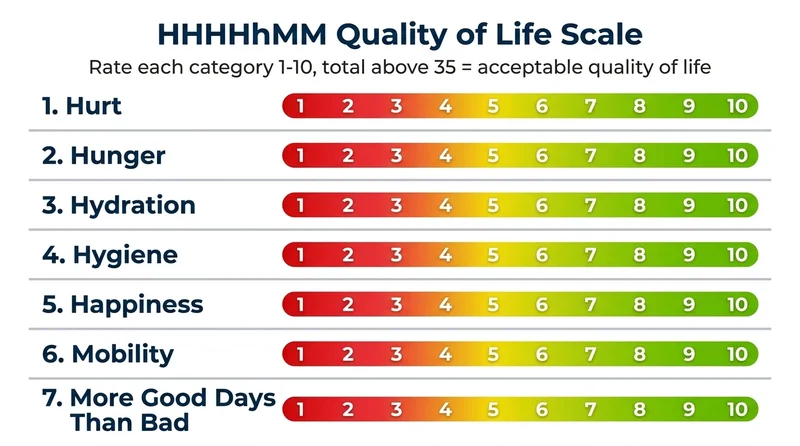
Emotion clouds judgment during these weeks. Structured frameworks cut through the fog and give you something concrete to evaluate, day by day.
How the HHHHHMM Scale Works
Dr. Alice Villalobos, a veterinary oncologist who pioneered pet hospice care, developed this quality of life scale. It evaluates seven categories, each scored from 1 (worst) to 10 (best):
| Category | What You're Assessing |
|---|---|
| Hurt | Is pain controlled? Can your pet rest without whimpering, trembling, or guarding? |
| Hunger | Are they eating willingly? Hand-feeding counts, but force-feeding does not |
| Hydration | Drinking enough? Check gum moisture and skin elasticity (pinch test on the scruff) |
| Hygiene | Can they keep themselves clean? Are there wounds, pressure sores, or persistent soiling? |
| Happiness | Any tail wags? Purrs? Interest in surroundings? Do they still seek your company? |
| Mobility | Can they stand, reposition, and reach food and water without assistance? |
| More Good Days Than Bad | Over the past two weeks, count the genuinely good days versus the difficult ones |
Totals above 35 out of 70 generally suggest acceptable quality of life. Below 35, a serious conversation about euthanasia is warranted.
Context matters more than the total, though. Scoring 8 in six categories and 1 in Hurt still means suffering. One category in crisis can outweigh everything else.
Track the Trend, Not the Snapshot
Score your pet once a week, same day, same time. Write it down. Stick a calendar on the refrigerator.
What you're watching for is trajectory. Dropping from 42 to 38 to 31 over three weeks tells a clear story, even if no single day felt like the "worst." Decline across multiple categories simultaneously is the pattern experienced veterinarians recognize as the signal that quality of life is slipping away.
Your Pet's Favorites List
Write down five things your pet loves most. Walking to the mailbox. Lying in the spot where sun hits the carpet at 3 p.m. Belly rubs after dinner. Hearing your car in the driveway. Chasing squirrels through the window.
When three or more of those five things no longer bring a response, that tells you where quality of life stands -- in terms your pet has defined for themselves.
How to Make the Decision: A Step-by-Step Guide
Knowing the signs and having a framework still leaves you facing the hardest part: actually deciding. Here's a practical path through it.
Step 1: Talk to your veterinarian. Bring your QoL scores. Describe what you've observed at home. Ask your vet to assess pain level, prognosis, and whether any remaining treatment options exist that would genuinely improve comfort rather than just extend time. Good veterinarians won't tell you what to do, but they'll tell you what they see -- and that objectivity proves invaluable when grief distorts your own perception.
Step 2: Involve your family. Everyone who loves this pet deserves a voice. Children old enough to understand benefit from being included in the conversation rather than blindsided by the outcome. Share your QoL scores. Let people ask questions. Give everyone space to express what they're feeling.
Step 3: Consider the "a day too early" perspective. Veterinarians who specialize in end-of-life care share this observation consistently: across their careers, far more pets suffered because families waited too long than because families acted too soon. Guilt from "did I give up too early?" is painful but finite. Guilt from "I let them suffer because I wasn't ready" tends to linger longer and cut deeper.
Step 4: Address guilt before it arrives. Guilt is coming regardless. Name it now. You are not "putting your pet down." You are choosing to end suffering when medicine has nothing more to offer. Veterinarians don't view euthanasia as failure. They view it as the final act of responsible care -- a decision made from love, not surrender.
Step 5: Set a timeline that respects your pet's comfort. Once you've decided, delaying for weeks to "get ready" risks allowing your pet to deteriorate further. Some families choose a specific date within the next few days. Others tell their vet: "When you see the next significant decline, we're ready." Both approaches are valid. Your pet's comfort should drive the schedule, not avoidance.
In-Home Euthanasia: A Peaceful Alternative

Your pet spent their life in your home. More Orlando families are choosing to let their pet's final moments happen there, too.
In-home euthanasia eliminates every stressor that makes the clinic experience harder than it needs to be. No wrestling your 90-pound Lab into the car with hips that barely work. No fluorescent-lit waiting room. No unfamiliar smells or sounds from other animals.
Your pet stays on their own bed, their own blanket, in the room where they've napped a thousand times. Veterinarians come to them. Typically lasting 45 to 90 minutes, the process is unhurried, with time for the family to be together before, during, and after.
Other pets in the household can be present. Surviving dogs and cats who witness the passing tend to show fewer searching behaviors afterward. They understand their companion is gone rather than endlessly waiting for them to come home.
For a complete walkthrough of what the process looks like, what it costs, and how to prepare your home, read our complete guide to pet euthanasia in Orlando. That guide covers everything from the sedation process to aftercare options and pricing ($250-$400 for in-home euthanasia in Orlando, versus $150-$250 at a clinic).
We provide mobile veterinary services in Sanford and throughout the greater Orlando area. If you'd like to talk through whether it's time, call (877) 345-4326. No pressure, no obligation.
Coping With Pet Loss and Grief
Making the decision doesn't end the hard part. It begins a different kind of hard.
Grief after losing a pet catches people off guard with its intensity. You shared 10, 15, maybe 18 years of daily routine with this animal. They heard your alarm clock every morning. They were the last face you saw before sleep. That absence reshapes your entire day, and the emptiness is legitimate.
Expect the first week to be the worst. You'll reach for the leash. You'll hear phantom collar tags. Quiet in the house will feel wrong at the moments your pet was most present -- early morning, after work, bedtime.
Give yourself permission to grieve without qualifying it. "It was just a pet" is something no one who has loved an animal believes, and you don't owe anyone an explanation for the depth of what you feel.
Memorialization helps. Clay paw prints. Framed photos in their favorite spot. Planting a tree in the yard. These aren't sentimental gestures -- they're anchoring points that acknowledge your pet existed, mattered, and left a mark.
When grief needs professional help: if you can't function at work after two weeks, if guilt about the timing hasn't eased, if intrusive thoughts about whether your pet suffered keep surfacing -- reach out. Call the ASPCA Pet Loss Hotline at (877) 474-3310 to speak with trained counselors. Pet loss grief is a recognized specialty in counseling, and seeking support isn't weakness. It's self-awareness.
Your Pet Gave You Their Best Days
Returning the favor means making this choice when the time comes -- not a day late because you weren't ready, but on the day your pet needs you to be brave for them.
If your pet is declining and you want a professional assessment, our veterinary team will talk it through with you. Call (877) 345-4326 for a conversation. No pressure, no sales pitch. Veterinarians who have helped hundreds of Orlando families through this moment will help you see clearly when emotions make that hard.
Your pet trusted you with their life. Trust yourself with this decision.
This article is for informational purposes. Every pet's situation is unique. Please consult your veterinarian for personalized guidance about your pet's end-of-life care.
References
- American Veterinary Medical Association (AVMA). "AVMA Guidelines for the Euthanasia of Animals." avma.org/resources-tools/avma-policies/avma-guidelines-euthanasia-animals
- Villalobos, A. E. "Quality of Life Scale (HHHHHMM Scale) for Pets." Veterinary Practice News, 2004. Pawspice / Veterinary Oncology Consultants.
- Ohio State University Veterinary Medical Center. "How Do I Know When It's Time?" Quality of Life Assessment Resources. vet.osu.edu
- ASPCA. "Grieving the Loss of a Pet." aspca.org/pet-care/general-pet-care/grieving-loss-pet
- International Association for Animal Hospice and Palliative Care (IAAHPC). "Animal Hospice and Palliative Care Guidelines." iaahpc.org
Frequently Asked Questions

Our team of licensed veterinarians brings compassionate care directly to your home.