- Does Pet Insurance Cover Dog Dental Cleaning?
- Routine Cleaning vs. Dental Illness: What's the Difference?
- Which Pet Insurance Plans Cover Dental Cleaning?
- How Much Does Dog Dental Cleaning Cost Without Insurance?
- What About Cat Dental Insurance?
- How to File a Dental Insurance Claim
- Tips to Reduce Dental Costs (With or Without Insurance)
- What This All Comes Down To
- References
Your dog's dental cleaning estimate just came back at $400. You immediately wonder: "Does my dog insurance cover dental cleaning?" You open your policy documents, scan through 30 pages of exclusions, and end up more confused than when you started.
It's a common frustration. Pet dental coverage is one of the most misunderstood parts of pet insurance, and insurance companies don't make it easy to figure out. Short answer: most base plans do not cover routine dental cleanings. They do, however, cover dental illness and accidents. And that distinction between those two categories determines whether your insurance pays the bill or you do.
We break down exactly what pet insurance dental coverage includes, which providers offer dental plans, how much you'll actually spend in Orlando with and without coverage, and when buying a dental add-on makes financial sense. Our team processes insurance claims every week from mobile dental cleaning patients, so this comes from real invoices, not marketing copy.
Does Pet Insurance Cover Dog Dental Cleaning?
Pet insurance splits dental care into three categories, and each one gets treated differently by your policy.
Routine dental cleanings (preventive care). Annual or biannual professional cleanings to remove tartar and polish teeth. Think of it like your own twice-yearly dentist visit. Standard pet insurance plans exclude routine cleanings entirely. Getting reimbursement requires a wellness add-on or preventive care rider.
Dental illness. Gingivitis, periodontal disease, tooth root abscesses, stomatitis, and similar conditions diagnosed by a vet. Comprehensive accident-and-illness plans cover dental illness treatment, including cleanings, X-rays, and extractions required to address a diagnosed condition. Many pet owners already carry this coverage without realizing it.
Dental accidents. Broken teeth from chewing bones, cracked canines from falls, jaw trauma from being hit by a car. Accident coverage in your base plan typically handles these. No add-on needed.
Confusion happens because pet owners hear "dental cleaning" and assume none of it is covered. In reality, if your vet diagnoses dental disease during a cleaning and documents it on the invoice, your accident-and-illness plan likely pays for the treatment portion. But cleanings performed purely for prevention on healthy teeth stay out of pocket unless you carry a wellness add-on.
Routine Cleaning vs. Dental Illness: What's the Difference?
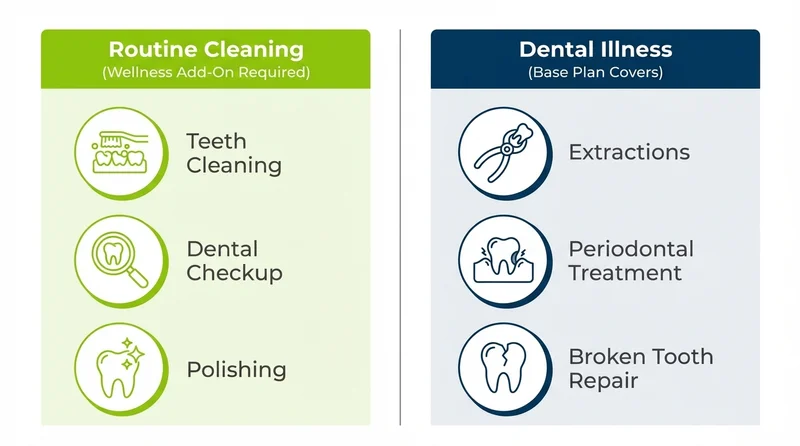
This distinction determines your reimbursement, so it's worth understanding clearly.
Routine (preventive) cleaning means your dog's teeth are in reasonable shape. No diagnosed disease, no pathology. You're removing surface tartar to keep things that way. Insurance companies classify this alongside annual wellness exams and vaccinations: maintenance, not treatment.
What counts as routine: - Annual professional scaling and polishing - Checkups with no abnormal findings - Fluoride treatment - Pre-anesthetic bloodwork for elective cleaning
Dental illness means your vet has diagnosed a condition that requires treatment. At that point, the cleaning becomes a medical procedure, not maintenance.
What counts as dental illness: - Gingivitis (inflamed gums from bacterial infection) - Periodontal disease (bone loss around teeth) - Tooth root abscess - Fractured teeth requiring extraction - Stomatitis (severe oral inflammation, especially in cats) - Tooth resorption (common in cats)
Here's where it gets practical. Say your vet examines your dog and finds Stage 2 periodontal disease on the lower premolars. Cleanings, X-rays, and two extractions required to treat that disease are a medical procedure, and your accident-and-illness plan covers it. Same dog, same cleaning table, but the insurance outcome depends on what the vet documents on the chart.
Documentation matters more than most owners realize. Vets who write "routine dental cleaning" on an invoice get that claim denied. Vets who write "dental cleaning and extractions for treatment of periodontal disease, Stage 2" get it approved. We've learned this from hundreds of claims over the years.
Which Pet Insurance Plans Cover Dental Cleaning?
Plans vary widely between providers, and details change often. Here's a snapshot of what major carriers offer as of early 2026.
Lemonade. Base accident-and-illness plan covers dental illness. Add their Dental Care add-on ($9-$15/month extra) for one annual routine cleaning. Lemonade's Preventative+ package bundles dental with vaccines and wellness exams.
Embrace. Covers dental illness on the base plan, up to $1,000 per incident. Wellness Rewards add-on ($15-$30/month) reimburses routine cleanings up to your selected annual limit.
Nationwide. Whole Pet with Wellness plan covers routine dental cleanings. Base Major Medical plan covers dental illness only. Nationwide is one of the few carriers that bundles dental cleaning into a comprehensive plan rather than requiring a separate add-on.
ASPCA Pet Health Insurance. Base plan covers dental illness. Preventive Care add-on ($10-$20/month) includes one routine cleaning per year.
Fetch (formerly Petplan). Covers dental illness and accidents on the base plan. Routine cleaning isn't available, even as an add-on.
Spot. Base plan covers dental illness. Preventive care add-on covers cleanings. Two tiers available, with the higher tier covering more per cleaning.
Trupanion. Covers dental illness from periodontal disease and accidents. Routine cleaning is excluded, and there's no wellness add-on for dental.
| Provider | Dental Illness | Routine Cleaning | Add-On Cost |
|---|---|---|---|
| Lemonade | Base plan | Dental Care add-on | $9-$15/mo |
| Embrace | Up to $1K/incident | Wellness Rewards | $15-$30/mo |
| Nationwide | Whole Pet plan | Whole Pet with Wellness | Bundled |
| ASPCA | Base plan | Preventive Care add-on | $10-$20/mo |
| Fetch | Base plan | Not available | N/A |
| Spot | Base plan | Preventive Care add-on | $10-$25/mo |
| Trupanion | Base plan | Not available | N/A |
Worth noting: waiting periods apply to dental coverage across the board, typically 14 days for accidents and 30 days for illness. Pre-existing dental conditions are excluded by every carrier. And keep in mind that the monthly cost of a dental wellness add-on ($10-$30/month, or $120-$360/year) needs to be weighed against an actual cleaning ($250-$450 once a year).
How Much Does Dog Dental Cleaning Cost Without Insurance?
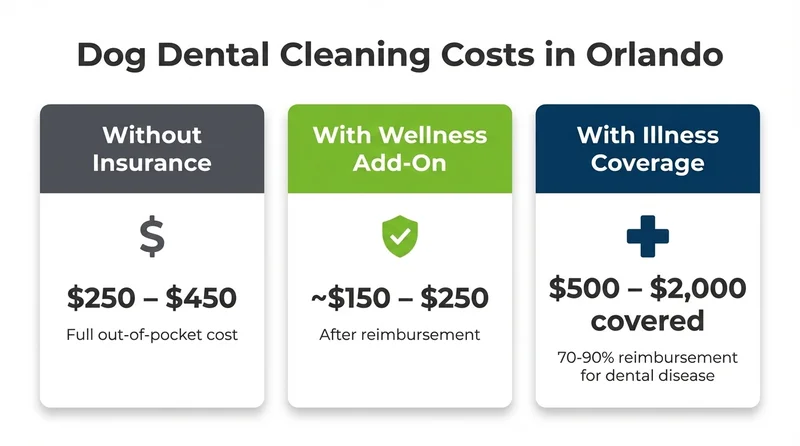
In Orlando, dental cleaning prices cluster within a predictable range:
| Service | Orlando Price Range |
|---|---|
| Anesthesia-free cleaning | $250-$300 |
| Full cleaning under sedation | $350-$450 |
| Pre-anesthesia bloodwork | $85-$120 |
| Dental X-rays | $95-$150 |
| Extractions (per tooth) | $75-$250 |
For a detailed breakdown of what drives these prices up or down, see our complete guide to dog dental cleaning costs in Orlando.
Break-even math on insurance. Wellness add-ons that cover dental cleaning cost $10-$25 per month, which works out to $120-$300 per year. One routine cleaning runs $250-$450. At the low end ($120/year add-on, $450 cleaning), you save $330. At the high end ($300/year add-on, $250 cleaning), you're paying $50 more than the cleaning itself.
Where dental insurance clearly pays for itself: unexpected illness. Picture a dog with periodontal disease needing four extractions. Expect a bill of $1,200 to $2,000 or more. If your base accident-and-illness plan covers dental illness at 80% reimbursement after a $250 deductible, you're looking at roughly $440 out of pocket instead of $1,800. A single incident like that justifies years of premiums.
According to the AVMA, over 80% of dogs develop dental disease by age 3. This isn't an "if" scenario for most pet owners. It's a "when."
Orlando-specific note. Florida's humidity accelerates bacterial growth, which means tartar buildup happens faster here than in drier states. Our mobile vet team sees dogs in the Orlando metro who need cleanings every 8 to 10 months rather than the standard 12-month interval. More frequent cleanings make the insurance math tilt in favor of coverage.
What About Cat Dental Insurance?
Cats face their own set of dental problems, and insurance handles them similarly to dogs with a few key differences.
Tooth resorption affects an estimated 20-60% of cats and causes teeth to slowly dissolve from the inside. It's painful, progressive, and almost always requires extraction. Pet insurance plans cover tooth resorption under dental illness because it's a diagnosed disease, not routine care.
Stomatitis causes severe inflammation of the mouth lining. Treatment often involves extracting most or all teeth, a procedure that runs $1,500 to $3,000. Cat insurance dental coverage through a base accident-and-illness plan typically reimburses 70-90% of stomatitis treatment after the deductible.
For routine cat dental cleanings, the same rules as dogs apply: excluded from base plans, available through wellness add-ons. Cats are notorious for hiding oral pain, which means by the time symptoms show up, the problem has usually progressed past "routine." Having dental illness coverage on your cat's policy is arguably more important than on your dog's, because cat dental problems tend to be discovered at a more advanced (and expensive) stage.
How to File a Dental Insurance Claim
Filing a pet insurance dental claim is straightforward when you have the right paperwork. Here's the process, step by step.
-
Check your policy first. Before the dental appointment, call your insurance provider and confirm what's covered. Ask specifically whether your plan covers dental illness, routine cleaning, or both. Some carriers require pre-authorization for dental procedures over a certain dollar amount.
-
Get the procedure done. Your vet performs the cleaning, X-rays, and any extractions needed. Make sure your vet documents any diagnosed conditions on the medical record and invoice. "Treatment of periodontal disease" gets covered. "Routine cleaning" on a dog with periodontal disease gets denied unnecessarily.
-
Collect your itemized invoice. You need a line-by-line breakdown: exam fee, anesthesia, X-rays, scaling, polishing, each extraction listed individually, medications prescribed. Carriers reject lump-sum invoices.
-
Submit the claim. Providers accept claims through apps or online portals. Upload the invoice, attach the medical records, and submit. Some carriers like Trupanion offer direct-pay to the vet, which means you don't pay upfront.
-
Wait for reimbursement. Processing takes 5 to 14 business days depending on the carrier. Straightforward claims process faster. Claims that need additional documentation take longer.
One advantage of mobile vet dental care: every invoice we generate is itemized and formatted specifically for insurance submission. We've processed enough claims to know what carriers want to see, and we document accordingly. Clients tell us this saves them the back-and-forth that happens when a clinic sends a vague receipt.
Tips to Reduce Dental Costs (With or Without Insurance)
Insurance or not, preventive habits save more money than any policy.
Brush your dog's teeth daily. Sixty seconds with enzymatic toothpaste is the most effective way to slow tartar buildup between professional cleanings. Dogs that get daily brushing can stretch to 18 months between cleanings instead of 12, saving one $300-$450 bill over two years.
Use VOHC-approved dental chews. Look for the Veterinary Oral Health Council seal on packaging. These chews won't replace brushing, but they reduce plaque accumulation by 15-20%.
Don't postpone cleanings. Paying $300 today beats a $1,800 extraction bill next year. Every month of delay gives tartar more time to harden and bacteria more time to damage gum tissue. Catching periodontal disease at Stage 1 is a cleaning. Catching it at Stage 3 is surgery.
Schedule dental exams during wellness visits. Combining a dental check with an annual wellness exam means one travel fee instead of two separate appointments. For multi-pet households, this adds up quickly.
Consider senior dog dental health early. Dogs over 7 need more frequent monitoring. Small breeds with crowded teeth (Yorkies, Chihuahuas, Dachshunds) often develop dental disease years earlier than large breeds. Starting a cleaning routine at age 2 or 3 costs far less over your dog's lifetime than starting at age 7 when three teeth already need extraction.
Keep your dog active. Regular exercise supports overall health, including immune function that fights oral bacteria. Orlando has no shortage of great parks where dogs can stay active and healthy year-round.
What This All Comes Down To
If you already carry a base accident-and-illness plan, you likely have dental illness coverage and don't know it. That's what saves you from a $1,500 surprise bill when your vet finds periodontal disease and three teeth that need extraction.
Coverage for routine cleanings (annual scaling and polishing when nothing is wrong) requires a wellness add-on. Whether that add-on is worth the monthly premium depends on how often your dog needs cleanings and what you'd spend without it.
From our side of the exam table, here's what we see most often in Orlando: a dog comes in for what the owner thinks is a routine cleaning, and we find Stage 2 periodontal disease on the back molars. That "routine" cleaning becomes a medical treatment, and the owner's base insurance plan covers 80% of the bill. Owners who struggle are the ones without any coverage, staring at a $1,200 invoice they weren't expecting.
Whether you carry insurance or not, teeth still need cleaning. Dental disease is the most common health condition in dogs, and Orlando's humidity doesn't do your pet's mouth any favors. Schedule a dental exam, ask your vet to check for disease, and bring your insurance card. You'd be surprised how often "routine" turns out to be covered.
Ready to get your pet's teeth checked? Call our mobile vet team at (877) 345-4326 and we'll come to you.
This article provides general information about pet insurance dental coverage. Coverage details, costs, and availability vary by provider, plan, and state. Always review your specific policy documents or contact your insurance provider for exact coverage terms. This is not insurance advice. Pricing and coverage details are current as of April 2026 and are subject to change.
References
- American Veterinary Medical Association (AVMA). "Pet Dental Care." avma.org/resources/pet-owners/petcare/pet-dental-care
- North American Pet Health Insurance Association (NAPHIA). "State of the Industry Report 2025." naphia.org
- Lemonade Pet Insurance. "Dental Care Coverage." lemonade.com/pet/explained/pet-insurance-cover-dental/
- Progressive Pet Insurance. "Does Pet Insurance Cover Dental?" progressive.com/answers/does-pet-insurance-cover-dental/
- Forbes Advisor. "Pet Dental Insurance: Coverage & Costs." forbes.com/advisor/pet-insurance/pet-dental-insurance/
- American Veterinary Dental College (AVDC). "Periodontal Disease." avdc.org
Pet Insurance Dental FAQ

Our team of licensed veterinarians brings compassionate care directly to your home.