- Why Dog Dental Cleaning Matters More Than You Think
- What Happens During a Dog Dental Cleaning
- Anesthesia vs. Anesthesia-Free: Which Does Your Dog Need?
- Anesthesia-Free Cleaning
- Full Cleaning Under Sedation
- Which Should You Choose?
- How Much Does Dog Dental Cleaning Cost in Orlando?
- Mobile vs. Clinic Dental Cleaning
- Signs Your Dog Needs a Dental Cleaning
- How to Save Money on Dog Dental Cleaning
- Your Dog's Teeth Deserve Better Than "Wait and See"
- References
Dog dental cleaning in Orlando costs $250 to $450, and finding that number shouldn't require a phone call. Reddit threads, Facebook groups, and Google searches all circle the same question: "How much does it actually cost?" Every result sends you to a service page with no pricing and a "call for details" button.
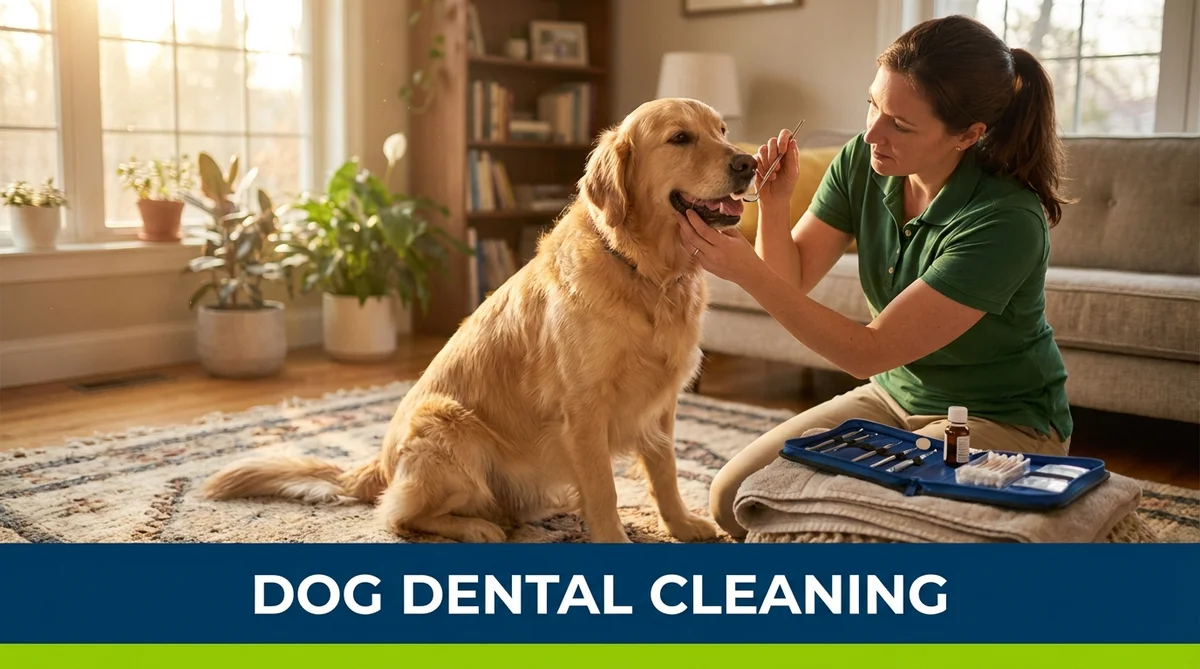
So here's the full picture. This guide covers what dog dental cleaning involves step by step, how much each piece costs in the Orlando metro, how to choose between anesthesia-free and sedated cleaning, and why a mobile vet dental cleaning at your home might be the option most people overlook.
Over 80% of dogs develop some form of dental disease by age 3, according to the American Veterinary Medical Association. Left alone, plaque hardens into tartar, tartar irritates gums, gum infection loosens teeth, and bacteria enter the bloodstream to damage the heart, liver, and kidneys. Spending $300 on a cleaning is cheap compared to a $2,000 emergency extraction.
Why Dog Dental Cleaning Matters More Than You Think
Bad breath is not normal. That's worth repeating because most dog owners assume their pet's breath is supposed to smell foul. Healthy dog breath is neutral, maybe slightly meaty. Persistent foul odor signals bacterial buildup that's already progressing toward disease.
Plaque, a soft film of bacteria, forms on teeth within hours of eating. Within 48 to 72 hours, it mineralizes into tartar that brushing can't remove. Tartar pushes under the gumline, causing gingivitis (red, inflamed gums). Untreated gingivitis becomes periodontal disease, which destroys the bone anchoring teeth in place. At that stage, teeth loosen, infections form abscesses, and bacteria circulate through the body.
Financially, the math is straightforward. Preventive cleaning costs $250 to $450. Surgical extractions for advanced dental disease run $2,000 to $4,000. Waiting doesn't save money. It multiplies the bill.
Florida's warm, humid climate accelerates bacterial growth, which means Orlando dogs may accumulate tartar faster than dogs in drier states. Annual professional cleanings are baseline. Small breeds with crowded teeth, like Yorkies and Chihuahuas, often need cleanings every 6 to 8 months.
Dental health connects directly to overall health as your dog ages. Senior dogs who already face joint pain and reduced mobility suffer more when chronic dental infection enters the mix — and that suffering is entirely preventable with routine care.
What Happens During a Dog Dental Cleaning
Understanding the process removes most of the anxiety around booking this procedure. Below is the step-by-step sequence for a full professional cleaning under sedation.
Pre-anesthesia exam and bloodwork. Your vet examines your dog's overall health and draws blood to check liver and kidney function. These organs process anesthesia drugs, so baseline values need to be normal before sedation. Bloodwork costs $85 to $120 and takes about 15 minutes for results.
Anesthesia induction and monitoring. After placing an IV catheter, the vet administers a sedation injection followed by gas anesthesia delivered through an endotracheal tube. Continuous monitoring tracks heart rate, oxygen levels, blood pressure, and body temperature throughout the procedure. Sedation allows the vet to work below the gumline, take X-rays, and perform extractions without causing pain or stress.
Full-mouth dental X-rays. Digital radiographs reveal bone loss, root infections, and fractured roots that are invisible during a visual exam. Roughly 60% of dental disease hides below the gumline, which is why X-rays are essential, not optional. Expect $95 to $150 for this step.
Ultrasonic scaling. Vibrating metal tips powered by ultrasonic waves break tartar off tooth surfaces, both above and below the gumline. Hand scaling follows for detailed work around tight spots and the gumline margin.
Polishing. Using a low-speed handpiece with pumice paste, the vet smooths enamel after scaling. Polishing matters because rough enamel attracts new plaque faster than smooth enamel. Skipping this step would accelerate re-tarring.
Extractions (if needed). Teeth with advanced bone loss, fractures, or root abscesses come out during the same procedure. Extraction cost varies: $75 to $250 per tooth depending on size, root structure, and difficulty. Multi-rooted teeth like upper molars cost more than single-rooted incisors.
Recovery. Once anesthesia gas is discontinued, your dog is monitored until fully awake. Expect grogginess for 4 to 8 hours. Offer soft food for 3 to 5 days, then gradually return to normal kibble. Most dogs bounce back within 24 to 48 hours.
Total procedure time: 45 minutes to 2 hours depending on severity. Simple cleanings with no extractions finish on the shorter end.
Anesthesia vs. Anesthesia-Free: Which Does Your Dog Need?
Few questions generate more debate among Orlando dog owners than anesthesia vs. anesthesia-free dental cleaning. Reddit threads go back years. Facebook groups fill with strong opinions on both sides. Here's what the clinical evidence actually supports.
Anesthesia-Free Cleaning
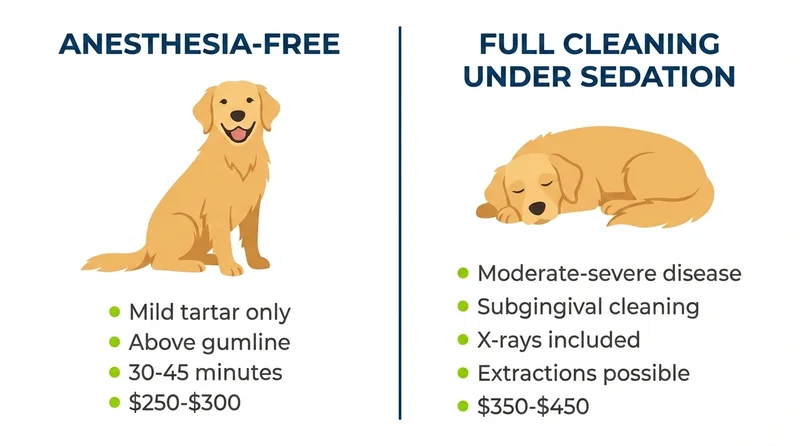
Hand scaling performed on an awake, restrained dog. Trained technicians use manual instruments to remove visible tartar from tooth surfaces above the gumline. No intubation, no IV, no sedation drugs.
Best for: dogs with mild to moderate surface tartar, healthy gums, calm temperament, and tolerance for mouth handling. Think maintenance cleanings on a dog whose dental health is already decent.
Limitations: reaching below the gumline is impossible, and that's where 60% of disease hides. X-rays aren't part of the procedure. Extractions aren't an option. Thoroughly cleaning inner (lingual) surfaces on resistant dogs isn't practical either. As the American Veterinary Dental College notes, anesthesia-free cleanings address cosmetic tartar but may miss disease underneath.
Cost: $250 to $300. Duration: 30 to 45 minutes.
Full Cleaning Under Sedation
Everything described in the previous section: bloodwork, anesthesia, X-rays, ultrasonic scaling above and below the gumline, polishing, and extractions if needed. This is the gold standard for comprehensive dental care.
Best for: dogs with moderate to severe tartar, gum disease, suspected root problems, any dog that needs X-rays or extractions, and dogs that won't tolerate an awake procedure.
Limitations: requires pre-anesthesia bloodwork and carries standard anesthesia risks (rare but real, estimated at 0.05% to 0.12% for healthy dogs). Costs more. Requires recovery time.
Cost: $350 to $450 (plus extras for bloodwork, X-rays, extractions). Duration: 45 minutes to 2 hours.
Which Should You Choose?
Mild tartar and a cooperative personality? Anesthesia-free cleaning provides genuine value as a maintenance tool between full cleanings. It isn't a substitute for comprehensive dental work, though. Think of it like a hygienist visit between deep cleanings at the dentist.
Red or bleeding gums, visible tartar along the gumline, loose teeth, or persistent bad breath after brushing all point to the full procedure with X-rays. Skipping sedation in those cases means missing the disease causing the most damage.
Nervous about anesthesia? That's reasonable. Modern veterinary anesthesia protocols are dramatically safer than they were even a decade ago. Pre-anesthesia bloodwork catches the dogs at highest risk. Continuous monitoring catches complications within seconds. Your vet can adjust the protocol for dogs with heart conditions or other risk factors. In nearly every case, the risk of untreated dental disease outweighs the risk of modern anesthesia.
Pets that already find vet visits stressful benefit from at-home dental care, which removes the clinic environment from the equation entirely.
How Much Does Dog Dental Cleaning Cost in Orlando?
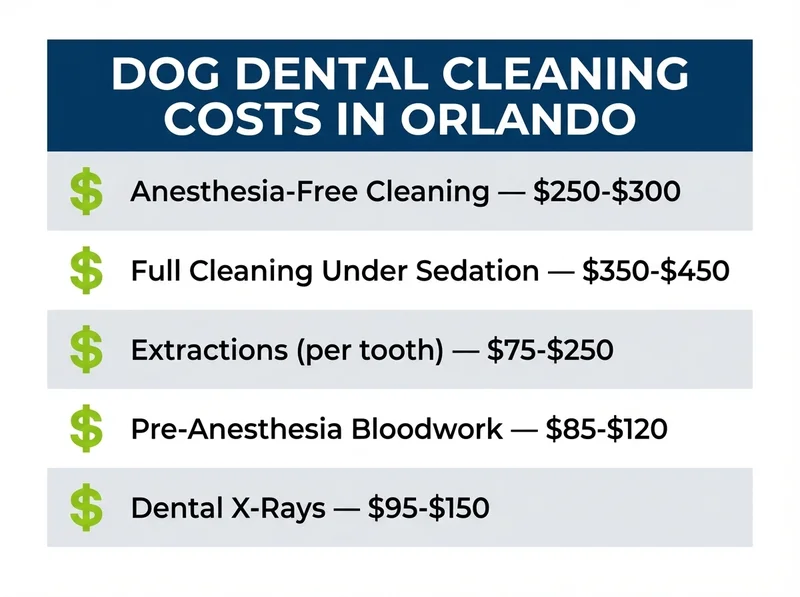
This is the section most people came here for. Not a single competitor in the Orlando area publishes actual prices on their dental pages. That changes here.
| Service | Price Range |
|---|---|
| Anesthesia-free cleaning | $250-$300 |
| Full cleaning under sedation | $350-$450 |
| Pre-anesthesia bloodwork | $85-$120 |
| Dental X-rays | $95-$150 |
| Extractions (per tooth) | $75-$250 |
What drives the price up or down:
- Dog size. Larger dogs require more anesthesia, longer procedure times, and bigger instruments. Chihuahua cleanings trend toward the low end. Great Danes trend toward the high end.
- Tartar severity. Dogs that haven't had a cleaning in years take longer to scale. More time under anesthesia means higher cost.
- Number of extractions. Each tooth adds $75 to $250 depending on root complexity. Upper molars with three roots cost more to extract than single-rooted lower incisors. Four or five extractions can add $500 to $1,000 to the base cleaning price.
- X-ray findings. Pre-extraction radiographs sometimes reveal additional teeth that need attention. Honest vets will call you during the procedure if the total changes significantly.
- Clinic vs. mobile. Mobile dental cleaning adds a travel fee ($50-$75 for the Orlando metro) but eliminates your drive time, waiting room stress, and the drop-off anxiety that makes many owners postpone the appointment entirely.
Real-world example: Imagine a 7-year-old, 65-pound Labrador with moderate tartar, one cracked premolar, and no prior cleanings. Full cleaning under sedation ($400) + bloodwork ($95) + X-rays ($120) + one extraction ($175) = approximately $790. That same dog in two more years, with advanced periodontal disease and four teeth needing extraction, faces a bill north of $1,800.
Pet insurance covers dental cleanings when they treat diagnosed dental disease. Routine preventive cleanings are typically excluded unless you carry a wellness add-on. Check your specific plan. We format every invoice for straightforward insurance submission.
See our complete guide to mobile vet costs in Orlando for a detailed look at how mobile pricing compares to clinic pricing across all services.
Mobile vs. Clinic Dental Cleaning
Most dental clinics require you to drop your dog off at 7 a.m. and pick them up at 4 p.m. You drive across town twice. Your dog spends the day in a kennel surrounded by other animals, post-anesthesia, groggy and confused. That's the standard approach, and it works. But it's not the only approach.
Mobile dental cleaning brings the procedure to your living room. Here's what actually travels in a mobile veterinary unit:
- Portable dental station with ultrasonic scaler and polishing handpiece
- Digital X-ray sensor that connects to a laptop for instant radiographs
- Anesthesia machine with isoflurane delivery and endotracheal intubation
- Multi-parameter monitoring for heart rate, SpO2, blood pressure, and temperature
- Surgical extraction kit for teeth that need to come out
Practical advantages go beyond convenience. Your dog wakes up from anesthesia on their own bed instead of a stainless-steel kennel floor. Recovery happens at home with their people, not in a building full of other recovering animals. Dogs with separation anxiety or fear of clinics experience measurably lower cortisol levels, which means more accurate bloodwork results and fewer post-procedure behavioral issues.
When should you choose a clinic instead? Complex oral surgery involving jaw fractures or tumor removal benefits from a fully equipped surgical suite with overnight monitoring capability. Standard cleanings and routine extractions are perfectly suited for mobile care.
Our mobile dental service covers the entire Orlando metro, including Lake Mary, Sanford, Celebration, Altamonte Springs, Kissimmee, and Winter Park. One travel fee covers dental work for every pet in the household. Two dogs needing cleanings? One trip, one travel fee.
Signs Your Dog Needs a Dental Cleaning
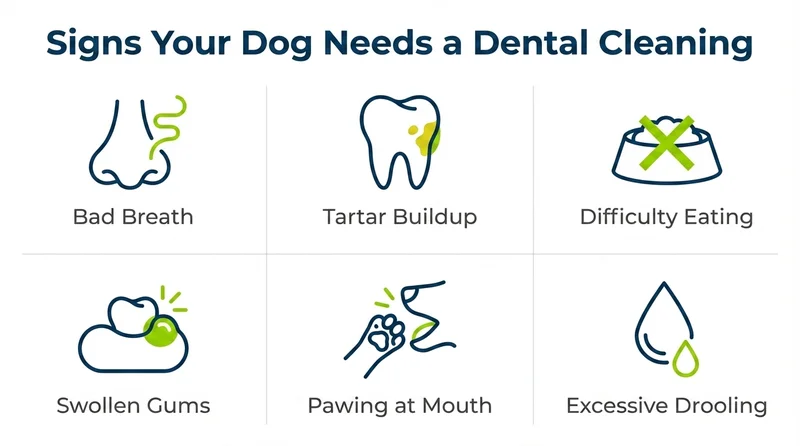
Dogs hide pain. This is hardwired survival behavior, not stoicism. By the time your dog stops eating or starts pawing at their mouth, the problem has been building for weeks or months. Catching dental disease early requires watching for subtler signals.
Bad breath that won't go away. Occasional dog breath after eating something questionable is one thing. Persistent foul or metallic odor signals bacterial infection, decaying food trapped between teeth, or gum disease. Normal dog breath should be relatively neutral.
Yellow or brown buildup on teeth. Lift your dog's lip and look at the back molars. Yellowish film is plaque (removable with brushing). Hard, brown or gray crust is tartar (requires professional removal). Tartar along the gumline is the most damaging because it pushes bacteria below where you can see.
Red, swollen, or bleeding gums. Healthy gums are pink and firm. Angry-red, puffy gums that bleed when your dog chews a toy indicate gingivitis, the early stage of periodontal disease. Caught at this stage, professional cleaning reverses the damage completely.
Difficulty eating or dropping food. Watch how your dog approaches the food bowl. Eager approach but ginger chewing, head tilting to one side, or kibble falling from the mouth — all signs that something hurts. Broken teeth, root abscesses, and severe gum recession all cause chewing pain.
Pawing at the mouth. Repeated face-rubbing against furniture, muzzle scratching, or persistent pawing at the mouth signals discomfort. Dental pain, foreign objects lodged between teeth, and oral tumors all trigger this behavior.
Excessive drooling. Some breeds drool naturally. But sudden increases in drooling, drool tinged with blood, or drool accompanied by reluctance to swallow points to oral pain or infection.
Spot any of these during a walk at one of Orlando's dog parks? Schedule a dental exam rather than waiting for the next annual visit. Early treatment is always simpler and cheaper.
How to Save Money on Dog Dental Cleaning
Dental cleaning is an investment in prevention, and prevention is always cheaper than treatment. Here's how to minimize the bill while keeping your dog's mouth healthy.
Brush daily. Sixty seconds with enzymatic dog toothpaste is the single most effective way to slow tartar accumulation between professional cleanings. Dogs that get daily brushing can often stretch 18 months between professional cleanings instead of 12. That's one fewer $300 to $450 bill over a two-year span.
Use dental chews strategically. VOHC-approved dental chews (look for the Veterinary Oral Health Council seal) reduce plaque by 15 to 20 percent. They're not a replacement for brushing, but they help. Avoid products that are too hard. If you can't dent it with your thumbnail, it can fracture a tooth.
Bundle with a wellness exam. During a mobile vet visit, dental cleaning combined with an annual wellness check means one travel fee instead of two separate trips. That saves $50 to $75 right there.
Don't postpone. Every month of delay allows tartar to harden further and inflammation to progress deeper. Cleaning that would have cost $300 six months ago might cost $800 now because two teeth need extraction.
Ask about package pricing. Many practices offer dental packages that bundle cleaning, bloodwork, and X-rays at a discount compared to paying separately.
Low-cost clinics exist. SPCA Florida and Humane Society clinics offer dental cleanings at reduced rates for qualifying owners. Wait times are longer and appointment availability is limited, but the care is legitimate. These clinics serve a real purpose for pet owners facing financial constraints.
Browse our complete guide to mobile vet costs in Orlando for a broader look at managing veterinary expenses.
Your Dog's Teeth Deserve Better Than "Wait and See"
Dental disease is the most common health problem in dogs. It's also one of the most preventable. Professional cleaning once a year, daily brushing at home, and paying attention to the warning signs described above keep most dogs out of the emergency extraction chair entirely.
Orlando has plenty of options for dog dental cleaning, from specialist clinics to mobile veterinary services that come to your front door. We bring the full dental setup to homes across the metro. Every patient gets a thorough cleaning and recovers on the couch instead of in a kennel.
Ready to schedule? Call us at (877) 345-4326 or book a dental cleaning directly. Check our full list of services or browse more guides on our blog.
Prices listed are approximate as of April 2026. Actual costs may vary based on your dog's size, dental condition, and location within our service area. Contact us for a personalized estimate. This article provides general information about dog dental cleaning; consult your veterinarian for advice specific to your pet.
References
- American Veterinary Medical Association (AVMA). "Pet Dental Care." avma.org/resources/pet-owners/petcare/pet-dental-care
- American Animal Hospital Association (AAHA). "Dental Care Guidelines for Dogs and Cats." aaha.org/aaha-guidelines/dental-care
- American Veterinary Dental College (AVDC). "Periodontal Disease." avdc.org
- Veterinary Oral Health Council (VOHC). "Accepted Products for Dogs." vohc.org
Dog Dental Cleaning FAQ
Our team of licensed veterinarians brings compassionate care directly to your home.